Online platform for student mobility applications:
https://erasmus.upet.ro
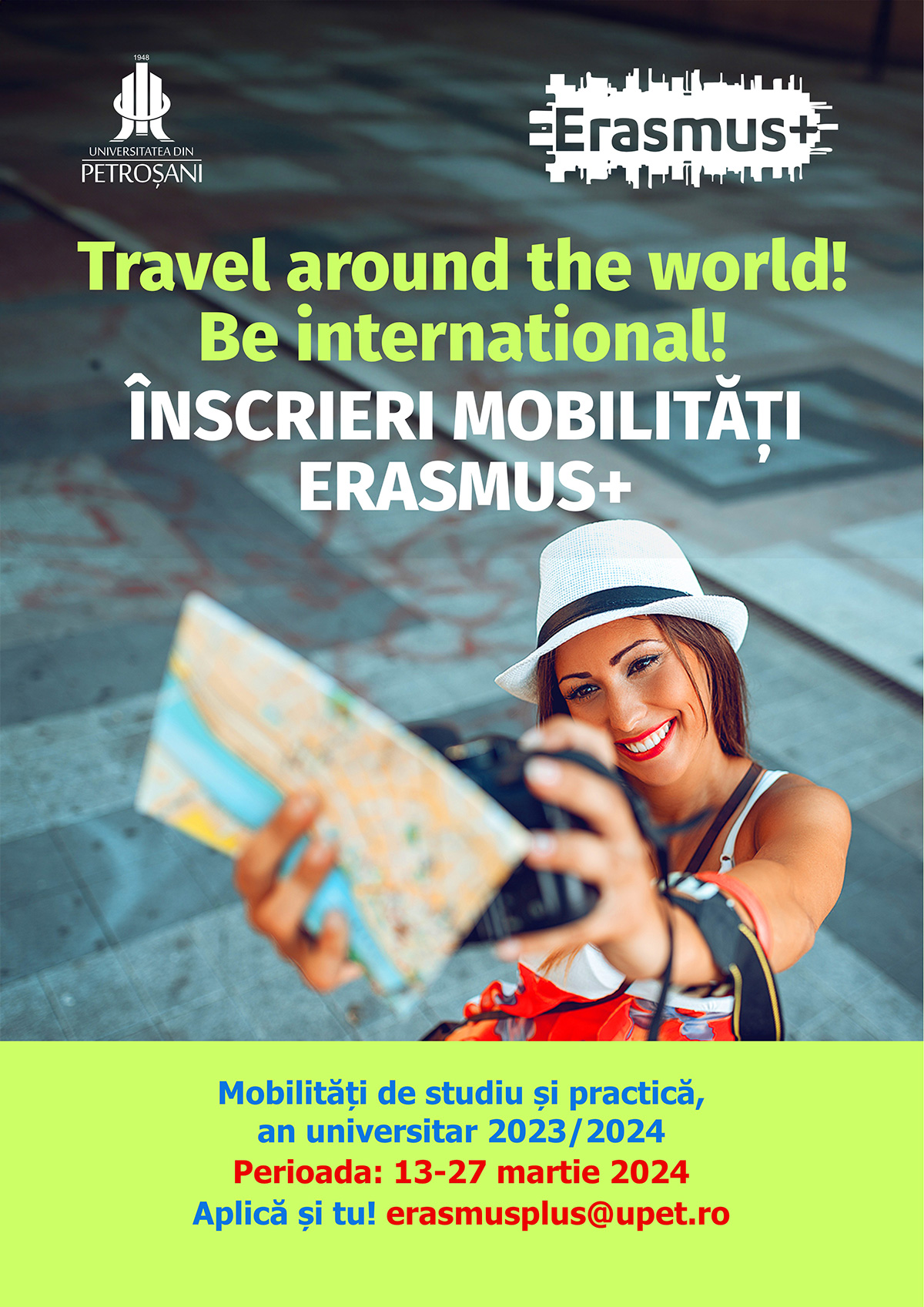
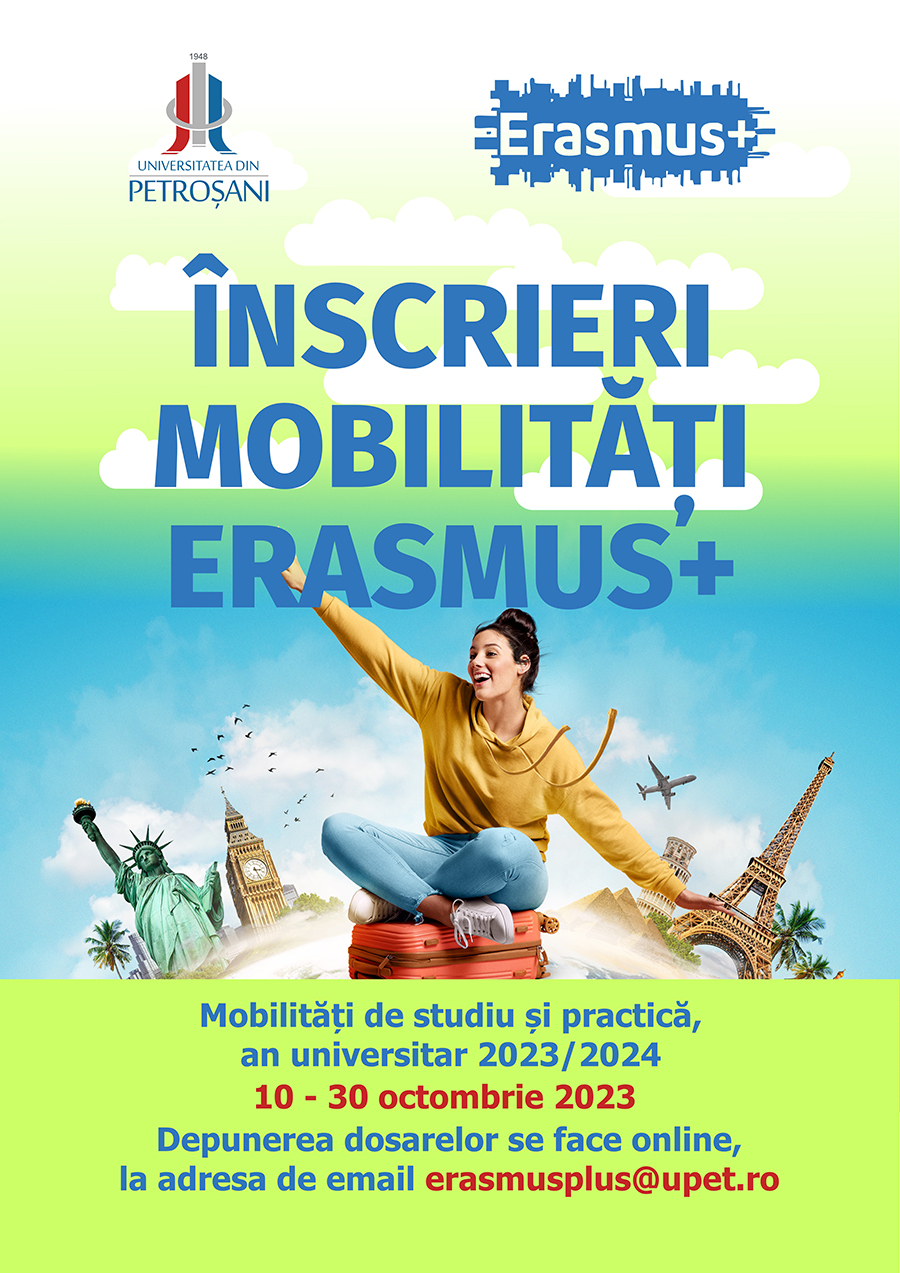
Online Registration for Student Mobility Programsfrom October 6 to 30, 2026
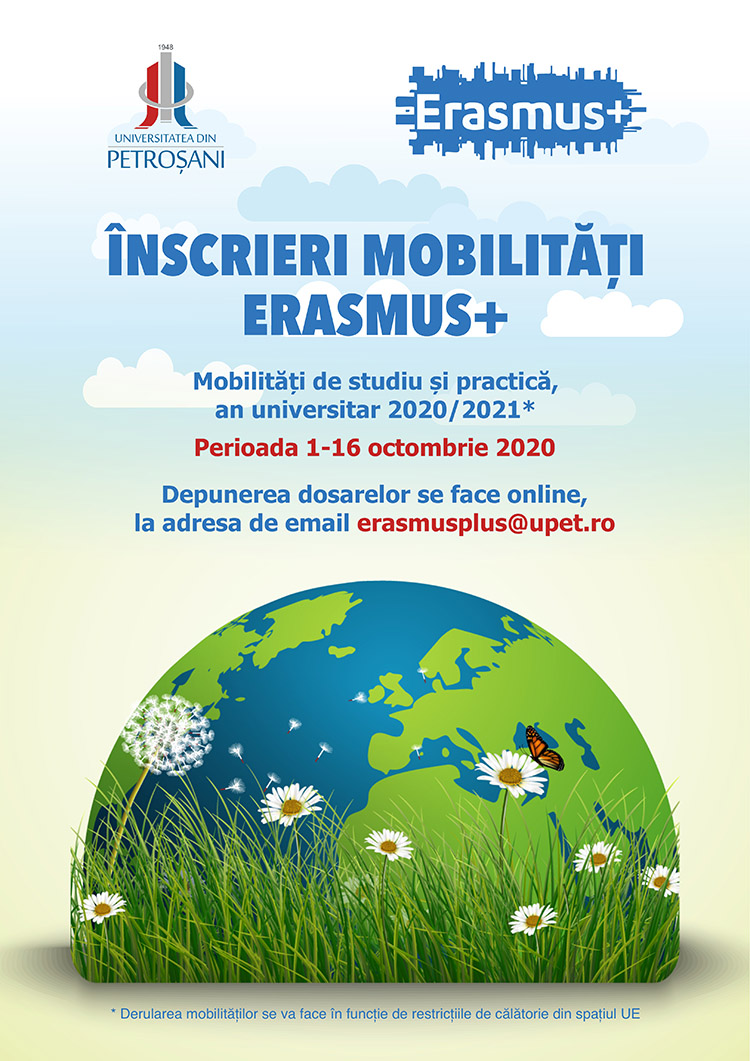
We would like to inform you that the application deadline for Erasmus+ student mobility programs has been extended to October 30, 2026. If you have any questions, need additional information, or encounter any difficulties during the registration process, please contact us at erasmusplus@upet.ro.
Erasmus + Overview
Erasmus Plus is a training opportunity for students and teachers in the European academic area. Helps students and teachers to benefit educationally, linguistically and culturally from the experience of studying/teaching or training in other European countries;
The main objectives of the Erasmus+ Program at the University of Petrosani are:
– to improve opportunities for access to a better life and career, both for students and university staff, through Erasmus mobilities;
– to encourage partnerships between the University of Petrosani and professional institutions, business and high-tech centers, from EU and non-EU countries, based on common professional interests.
– to increase the quality and performance of the educational system with a view to offering more attractive study programs by improving professional knowledge and enhancing the skills on offer – to promote international cooperation and combat discrimination of any kind.
Identifiers:
ECHE Number: 82442-EPP-1-2014-1-RO-EPPKA3-ECHE
Erasmus Code: RO PETROSA 01
Trends in Student and Faculty Mobility at the University of Petroșani for 2021–2025
- Regulation on the organisation of Erasmus+ Outgoing mobility
- UP Internationalization Strategy 2020-2027
- UP Internationalization Strategy

Erasmus+ Office
University of Petrosani
Director: univ.dr. Oana Ravaș
Secretary: Straja Karina, Lagy Rodica
Contact:Str. Universitatii, Nr. 20, Petrosani, Hunedoara, ROMANIA
+40254 542580 / 293
- Regulations Governing the Organization and Operation of the Department of International Relations
- Regulations on the Organization of Outgoing Erasmus+ Mobility Programs at the University of Petroșani
- Procedure for organizing mobility within Erasmus+ .pdf
- Procedure for the recognition of Erasmus+ student study mobility abroad.pdf
- Procedure for allocating, reimbursing and reporting Erasmus+ funds.pdf
- Procedure for Managing Erasmus+ Incoming Student Mobility.pdf
- Erasmus+ student mobility monitoring procedure.pdf
- ERASMUS+ mobility procedure for teachers and administrative staff (outgoing) teaching and training .pdf
- Risk Management and Risk Register Procedure .pdf
- Erasmus+ grant award procedure.pdf
- Operational Procedure for Granting Additional Financial Support (Top-Up) of 250 Euros
News, announcements, results
Results of the Erasmus+ Student and Doctoral Student Selection for 2025–2026
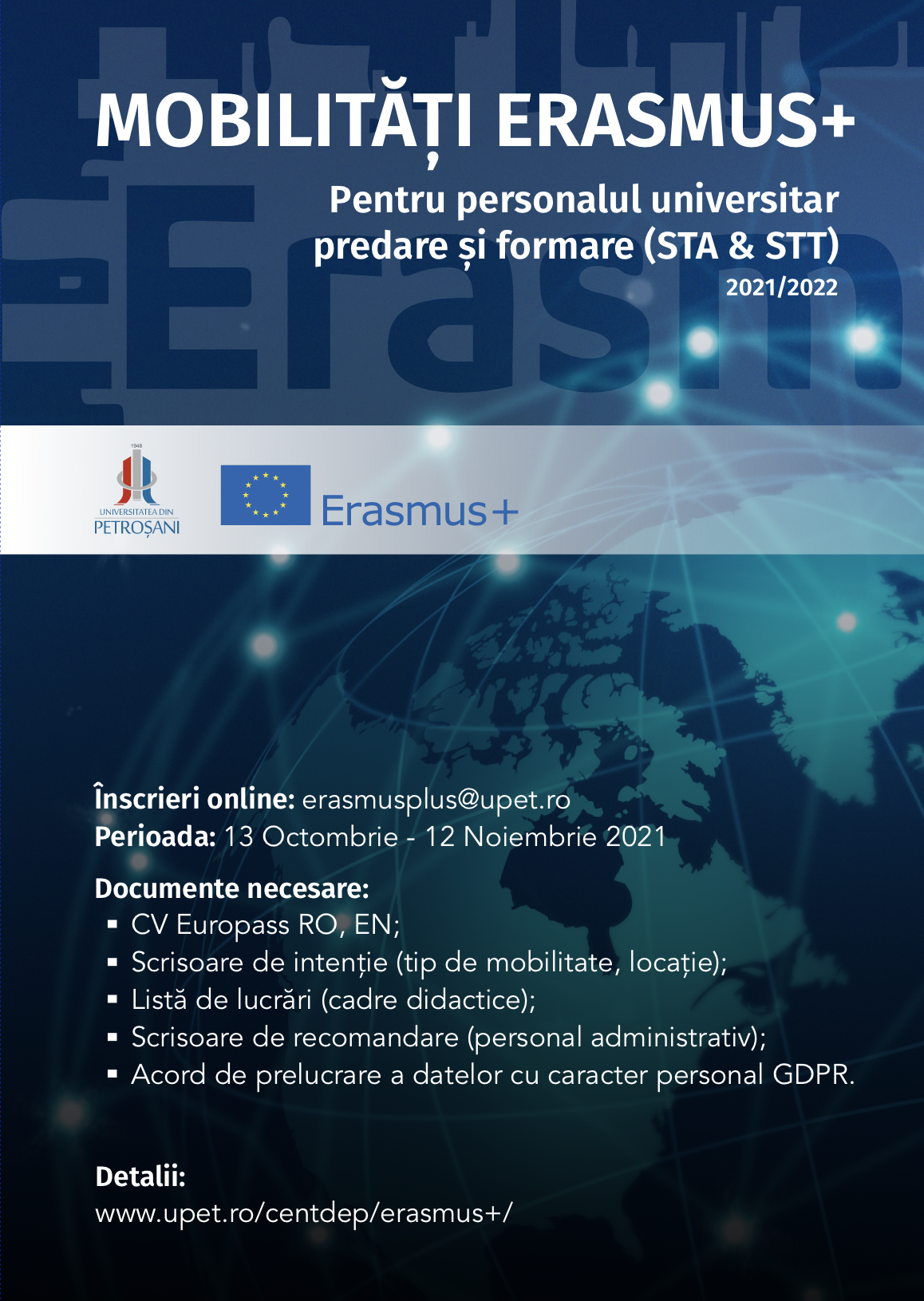
Results of the Selection Process for Training and Teaching Mobility Programs 2025–2026
ERASMUS Documents for Financial Aid Scholarships
ERASMUS+ STUDENTS MOBILITY SELECTION RESULTS UNIVERSITY YEAR 2024-2025 – application October 2024
Selection results training mobilities – teaching 2024-2025
Selection results ERASMUS student mobilities 2023-2024 – application March 2024
Selection results training mobilities – teaching 2023-2024
ERASMUS MOBILITY SELECTION RESULTS – STUDENTS 2023-2024
Call for additional funding for Erasmus+ mobilities.
Those interested, please read carefully and fill in the online application form.
Deadline, Friday March 12, 2021, 12 noon !!!
Calendar for the organisation of Erasmus mobilities:
May-June 2020:
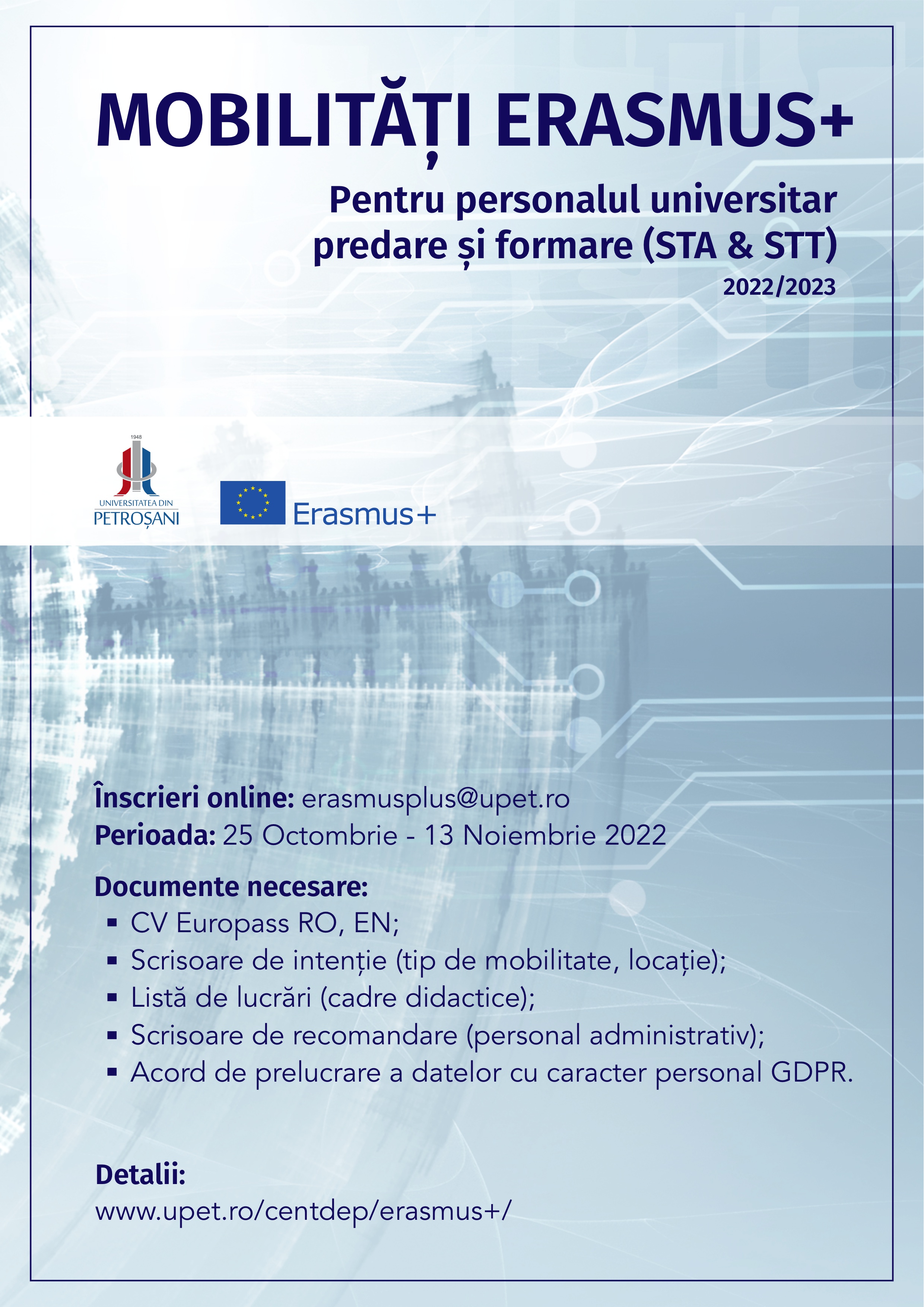
- Submission of applications: 18 May – 19 June
- Applications must be submitted online at erasmusplus@upet.ro
Testimonial
For me, Erasmus was much more than just an opportunity to study and conduct research abroad. It was an experience that helped me grow both professionally and personally, discover different cultures and traditions, meet new people, make friends, and establish collaborations that continue to this day.
During my mobility stints, I had the opportunity to work in laboratories, conduct experiments for my doctoral research, exchange ideas with professors and researchers, attend international conferences, and visit various mining areas. All of these activities contributed to my professional development and enriched my research experience.
My advice to anyone who wants to participate in an Erasmus exchange is to make the most of this opportunity, to be open-minded and curious, and not to be afraid to step outside your comfort zone. Erasmus means knowledge, experiences, friendships, and collaborations that can continue long after the exchange ends!

JITNIUC DANIELA (Roma)
My Erasmus+ experience in Rome was a wonderful exchange, and I’m glad I had the chance to take part in it. It was a dream come true, but also an opportunity to discover new things and break out of my daily routine. During my stay, I had the chance to discover the beauty of Rome, a city rich in history, culture, and traditions. I visited impressive sites, experienced the Italian way of life, met new people, and enjoyed every moment. The experience wasn’t limited to sightseeing. I had the chance to observe how a company operates, gain a better understanding of the organization and responsibilities in a professional setting, and supplement my theoretical knowledge with practical examples.
In closing, I can say that I am grateful for having been given this wonderful opportunity and that my experience has shown me how wonderful it is to learn and discover the world at the same time
ANDREEA AVRAM
How lucky it is to be a student and have an experience that opens up new horizons! For me, the Erasmus exchange in León, Spain, was much more than just an opportunity to study somewhere else. It was a wonderful adventure, full of discoveries, amazing people, and moments I’ll always cherish.
I had the opportunity to experience a different culture, discover new places, and meet people who enriched my experience. Every day brought something new: challenges, smiles, conversations, lessons, and memories. I learned to be more independent, to have more confidence in myself, and to see things from a different perspective.
Erasmus means stepping out of your comfort zone, taking risks, and enjoying the opportunities that student life has to offer. It’s an experience that helps you grow both professionally and personally and shows you that learning doesn’t stop at the classroom door.
I am grateful to the University of Petroșani for this opportunity, and I recommend it to everyone

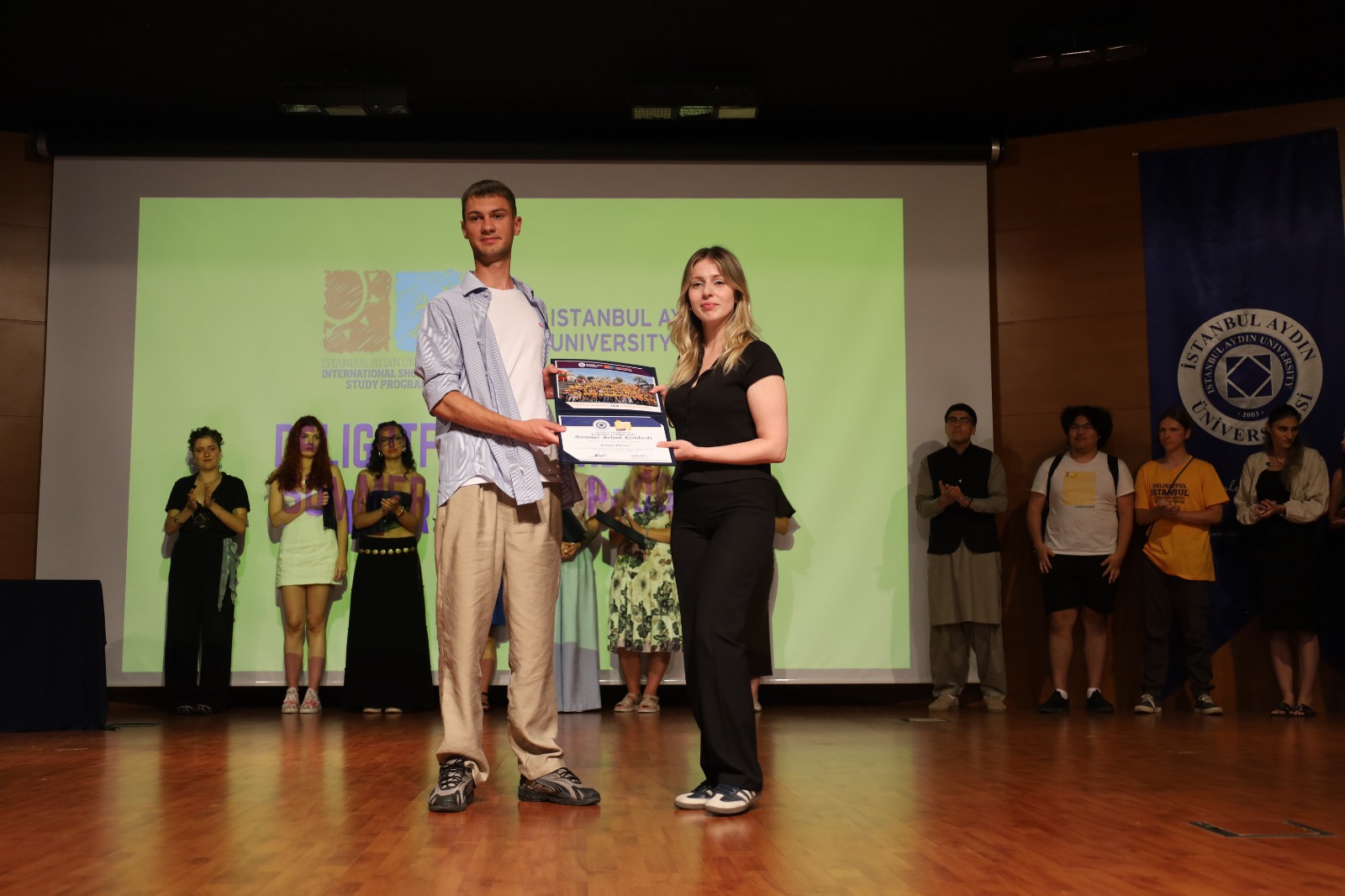
Participating in the Delightful Istanbul summer school through Erasmus+ was a memorable experience! I discovered Turkish culture, made international friends, visited impressive places, and developed my creativity and self-confidence.
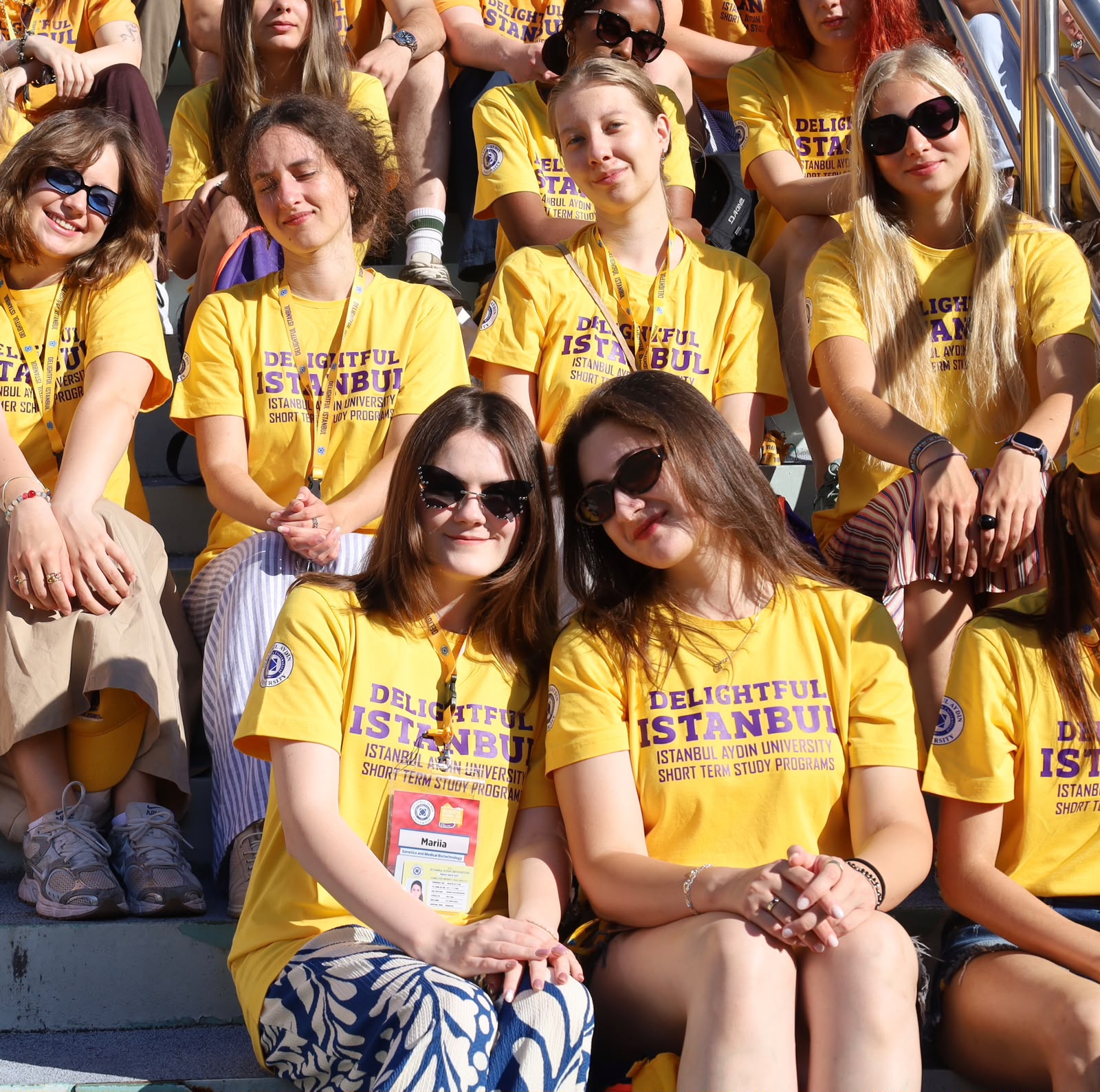
My Erasmus+ experience at Istanbul Aydın University, as part of the “Delightful Istanbul Summer School” program, was undoubtedly one of the most wonderful and meaningful experiences of my life.
Beyond the academic aspect and the opportunity to learn Turkish in an interactive way, what impressed me the most were the people I met. I had the chance to interact with students from different cultures and countries, discover new perspectives, and make friends that I hope to keep forever.
Exploring Istanbul, discovering local traditions, and all the organized activities turned every day into a special memory.
This mobility experience helped me step outside my comfort zone, become more open-minded and confident, and realize just how valuable the opportunities offered by Erasmus+ are.
If I had to choose again, I would say YES without a moment’s hesitation. My only regret is that I didn’t leave sooner!

ODOLEANU CRISTIAN (Viena)
The Erasmus+ program is an extraordinary opportunity for young people to discover other cultures, learn new things, and develop their personal and professional skills. It offers the chance to travel to other countries, meet people from different cultural backgrounds, communicate in foreign languages, and become more independent and confident.
My Erasmus+ experience in Vienna was truly special and memorable. I had the opportunity to explore Austria’s capital, an impressive city known for its elegant architecture, rich history, and unique atmosphere. I visited numerous tourist attractions, palaces, and historic buildings, which allowed me to discover Austrian culture and traditions. In addition to exploring the city, I participated in educational activities, through which I gained new knowledge and learned to work better as part of a team.
Another important benefit was interacting with new people, improving my communication skills, and overcoming language barriers. This experience also helped me become more responsible and more open to new things.
In conclusion, Erasmus+ isn’t just about travel—it’s also about education, friendships, and personal and professional growth. I recommend this experience to all young people!
Erasmus mobility for students
Erasmus is one of the most popular, loved and controversial student experiences. The aim of the university programme is to enable the exchange of students between countries. From the experience of former “erasmus” students translated into testimonials, they would tell us that student life is not complete unless you go through it. What exactly does Erasmus exchange mean? The programme allows you to go and study at another university in a European country for one or two semesters or to improve your knowledge by doing a minimum 2-month internship in a university/firm/institution in an EU country. You receive partial financial support, as the ERASMUS grant is able to partially cover your monthly expenses in your study country.
Why choose to be an Erasmus student?
You’ll travel and live temporarily in a foreign country, plus all the benefits and life lessons that come with it.
You will have the opportunity to get in touch with an education system different from the one in Romania, specific to each country, which can open up new horizons for you.
You will meet interesting people, whether they are other Erasmus students, people of different nationalities, or people from the country where you will go, intercultural exchange being one of the main aims of the programme.
You will grow up and learn to manage on your own (including cooking, cleaning, maintaining yourself, figuring out your money and expenses, managing in a different society from home).
You will become more adaptable, more flexible, more open-eyed to ideas and opportunities.
Culture shock and all the life experiences that come with it, which can open up new horizons and opportunities.
You need to know before you go:
The ERASMUS scholarship covers only part of your monthly expenses, and if you want to have as full an experience as possible in the country you are in, you may need an additional income
Equalising averages when you return home can take longer than you’d like in some cases.
The language barrier can be an inconvenience – if you go to a country and fail to learn part of the language.
- Erasmus-student-charter_en
- Erasmus-student-charter-en
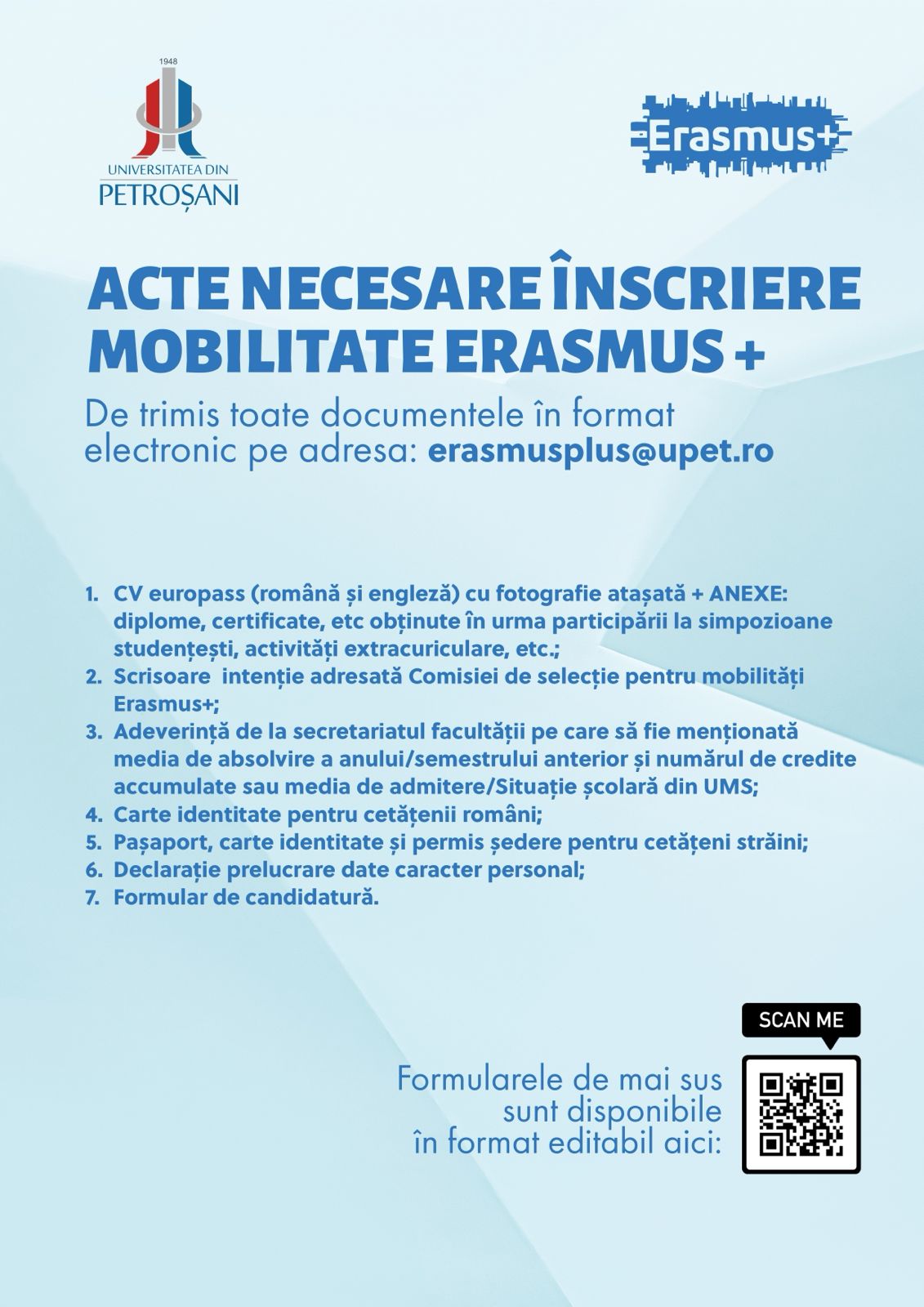
Documents required for students to submit the selection file:
- Application form for a study or internship mobility program.
- Certificate requested from the faculty secretariat showing that the applicant is a student at UPET and the previous year’s graduation average / UMS academic record
- Letter of intent written in Romanian and addressed to the ERASMUS+ Office.
- Europass format CV with inserted photo, written in Romanian and English.
- Identity card for Romanian citizens
- Passport, identity card and residence permit for foreign citizens
- Personal data processing declaration
Enterprises eligible for placement
“Enterprise” means any establishment engaged in economic activities in the public or private sector regardless of size, legal status or the economic sector in which it operates, including the social economy. It follows implicitly that, in addition to companies, the following can be considered as enterprises: higher education institutions, research centres, family businesses, partnerships and associations regularly involved in economic activities. Economic activity is the determining factor, not legal form.
Duration of student mobility
Students can spend between 3 and 12 months in a study mobility or between 2 and 12 months in a practice mobility (including a period of internship/placement, but not exceeding 12 months). The same student may receive a study or placement abroad grant of up to a maximum of 12 months per study cycle:
During the first cycle of study (Bachelor or equivalent)
During the second cycle of study (Master or equivalent)
During the third cycle of study (PhD level)
Criteria applicable to mobility and institutions
Student study mobility is based on inter-institutional agreements between the participating universities, each of which holds an Erasmus University Charter.
This condition does not apply between the home institution and the host company in the case of a placement. In certain situations a higher education institution may be the host enterprise for a student placement
As part of the placement, the student goes to gain work experience. Accordingly, the rules will be those applicable to the placement, such as the fact that an inter-institutional agreement between the participating institutions is not required and the host institution does not need to have an Erasmus Charter.
At least the country of origin or host country must be an EU Member State
The home institution will fully recognise the study period spent abroad using ECTS. In the case of a placement which is not part of the student’s study programme, the home institution will ensure recognition at least by recording the period completed in the Diploma Supplement and Europass Mobility.
No fees will be charged for registration, examination, laboratory access or facilities offered by the library of the host institution. Small fees may be charged for insurance, student associations, miscellaneous materials (photocopies, laboratory products) under the same conditions as for local students.
Erasmus+ App – Erasmus+ Mobility at Your Fingertips!
Through the app, students can discover international mobility opportunities, access information and practical advice, organize the steps of their mobility experience, and learn about events, services, offers, and discounts specifically for the Erasmus+ community.
Developed as part of the European Student Card Initiative (ESCI), the app helps digitize and streamline the Erasmus+ experience by providing access to information and services in one place.
Useful information for mobility
BEFORE mobility takes place:
- Selection of students is carried out
- A Learning/Training Agreement is issued (Guide for Completing the Learning /Training Agreement)
- The Learning/Training Agreement is signed by the three parties involved (the student, the home institution, and the host institution or company)
- The financial contract is concluded
-
Advance payment of 80% (up to 100%) of the total grant
Other documents required:
- ACT ADITIONAL
- Erasmus+ Student Charter
- STATEMENT
- EUROPASS MOBILITY
- LIST OF DOCUMENTS TO BRING FROM THE SCHOLARSHIP
- 2026_KA131-HED Annex_6_STUDENTS Sample_contract_with_participants
DURING mobility:
In the case of study mobility, studies are carried out on a full-time basis, including bachelor, master and doctoral studies (research activities not specifically part of the programme are not eligible).
In the case of placement, the grant is awarded for actual participation in training in a field that can be recognised as part of the student’s programme in the home institution
The grant may be awarded for a combined mobility, which involves a period of study and a placement period
Changes to the Learning/Training Agreement may occur within the first month of the student’s arrival at the host institution
During the first week of the placement, discussions take place with the mentor about the precise tasks that the student will have to perform
At the end the host institution/organisation must issue the certificate of participation and the enrolment sheet/training objectives sheet
AFTER returning from mobility:
- The student must submit to the Erasmus+ Office the documents proving the mobility, together with the final narrative report
- If found to be fulfilled, academic recognition will be secured and the remainder of the grant (if applicable) will be paid.
- It is necessary that the students who have carried out mobilities participate in the events organized by the University of Petroșani in order to disseminate information about their experiences and thus make visible the program through which they were awarded the grant.
- It is also advisable for former beneficiaries to join student organisations (such as ESN) or the www.studenterasmus.eu through which they can help future beneficiaries
The grant is a contribution to the costs of carrying out the mobility. The grant is calculated per month and paid as a lump sum. The amount of the grant is also determined by the European Commission according to the country of destination
Erasmus Play – Find the right housing for your Erasmus+ mobility!
Erasmus Play is an online platform for international students that makes it easier to find and compare housing options in university towns across Europe and other international destinations.Grid for equivalence of studies
Romania | 1-4 | 5 | 6 | 7 | 8 | 9 | 10 |
ECTS scale | FX.F Fail | E Sufficient | D Satisfactory | C Good | C Good | B Very Good | A Excellent |
Austria | 5 |
| 4 |
| 3 | 2 | 1 |
Bulgaria | 2 | 3 |
|
| 4 | 5 | 6 |
Belgium | 1 – 9 | 10 | 11 | 12 | 13,14 | 15, 16 | 17 – 20 |
Czech Republic | 5 |
| 4 |
| 3 | 2 | 1 |
Cyprus | 0.00 – 49.99 |
| 50.00 – 59.99 | 60.00 – 69.99 | 70.00 – 79.99 | 80.00 – 89.99 | 90.00 – 100.00 |
Croatia | 1.49-1.0 |
| 2.49-2.0 |
| 3.49-2.50 | 4.49-3.50 | 5.00-4.50 t |
Denmark | 0 – 5 |
| 6 | 7 | 8 – 9 | 10 | 11 – 13 |
Switzerland | <3,5 |
| 3,5 -4,0 |
| 4,01 – 4,50 | 4.51 – 5,0 | 5,01 – 6,0 |
Estonia | 0 – 50% |
| 51 – 60% | 61 – 70% | 71 – 80% | 81 – 90% | 91 – 100% |
Finland |
|
| 1 | 1 ½ | 2 | 2 ½ | 3 |
France | <10 | 10 – 10,49 | 10,5 – 10,99 | 11,0 – 11,49 | 11,5 – 12,49 | 12,5 – 14,49 | 14,5 – 20,0 |
Germany | >4,01 | 4 | 3,99 – 3,50 | 3,49 – 3,00 | 2,99 – 2,50 | 2,49 – 1,51 | 1,50 – 1,00 |
Greece | 2, 3, 4 |
| 5 | 6 | 7 | 8 | 9 – 10 |
Ireland | <25% | 25% – 39% | 40% – 44% | 45% – 54% | 55% – 69% | 70% – 84% | 85% -100% |
Iceland | 1-4 |
| 5 | 6 | 7 | 8 | 9 – 10 |
Italy | ≤ 17 | 18, 19 | 20 – 21 | 22 – 23 | 24 – 25 | 26 – 27 | 28 – 30+ |
Latvia | 1-4 Fail |
| 5 | 6 | 7 | 8 | 9 – 10 |
Liechtenstein | <3,5 | 3,5 – 3,99 | 4,0 – 4,49 | 4,5 – 4,99 | 5,0 – 5,49 | 5,5 | 5,51 – 6,0 |
Lithuania | 0 – 50% |
| 51 – 60% | 61 – 70% | 71 – 80% | 81 – 90% | 91 – 100% |
Luxemburg | 1 – 9 | 10 | 11 | 12 | 13,14 | 15, 16 | 17 – 20 |
Macedonia | 5,00-5,99 | 6,00-6,99 | 7,00-7,99 | 8,00-8,49 | 8,50-8,99 | 9,00-9,99 | 10,00 |
Malta | 0.00 – 34.00 |
| 35.00 – 44.00 | 45.00 – 54.00 |
| 55.00 – 69.00 | 80.00 – 100.00 |
United Kingdom | 0 – 39% | 40 – 49% | 50 – 54% | 55 – 59% | 60 – 64% | 65 – 69% | 70 – 100% |
Norway | 6 – 4,1 |
| 3,01 – 4 | 2,6 – 3 | 2,01 – 2,59 | 1,6 – 2 | 1 – 1,5 |
Netherlands | 1 -4 |
| 5 | 6 | 7 | 8 | 9 – 10 |
Poland | <3,0 |
| 3 | 3,01 – 3,49 | 3,50 – 3,99 | 4,00 – 4,49 | 4,50 – 5,00 |
Portugal | <10 | 10 | 11 | 12 – 13 | 14 – 15 | 16 – 17 | 18 – 20 |
Slovakia | 5 |
| 4 | 3,01 – 3,00 | 3 | 2 | 1 |
Slovenia | 1 – 5,9 | 6 | 6,1 – 6,9 | 7 – 7,5 | 7,6 – 7,9 | 8 – 8,99 | 9 – 10 |
Spain | <5 | 5,0 -5,49 | 5,5 – 6,49 | 6,5 – 7,49 | 7,5 – 7,99 | 8 – 8,99 | 9 – 10 |
Sweden | U |
| G |
| VG | ||
Hungary | 1,00 – 1,99 |
| 2,00 – 2,50 |
| 2,51 – 3,50 | 3,51 – 4,50 | 4,51 – 5, 00 |
Turkey | 1-4 | 4,5 – 4,99 | 5,00 – 6,49 | 6,5 – 6,99 | 7,00 – 7,99 | 8,00 – 8,99 | 9,0 – 10,0 |
Grants for academic staff (teaching / auxiliary)
Mobility of teaching, research and non-teaching staff – for training purposes supports the professional development of teaching and non-teaching staff in higher education institutions in the form of training events abroad (excluding conferences) and periods of direct job shadowing/training in a partner higher education institution or other relevant organisation abroad.
Teaching staff mobility for periods of teaching allows teachers from higher education institutions to teach at a partner higher education institution abroad. Staff mobility for teaching purposes can take place in any academic field/discipline.
“Teaching mobility” involves the movement of a teaching staff member from an Erasmus University Charter (EUC) higher education institution or a person from an enterprise to an EUC partner institution for the purpose of teaching.
“Training mobility” involves the movement of an academic or non-teaching staff member from an Erasmus University Charter (EUC) higher education institution to a higher education institution or an enterprise for the purpose of professional training.
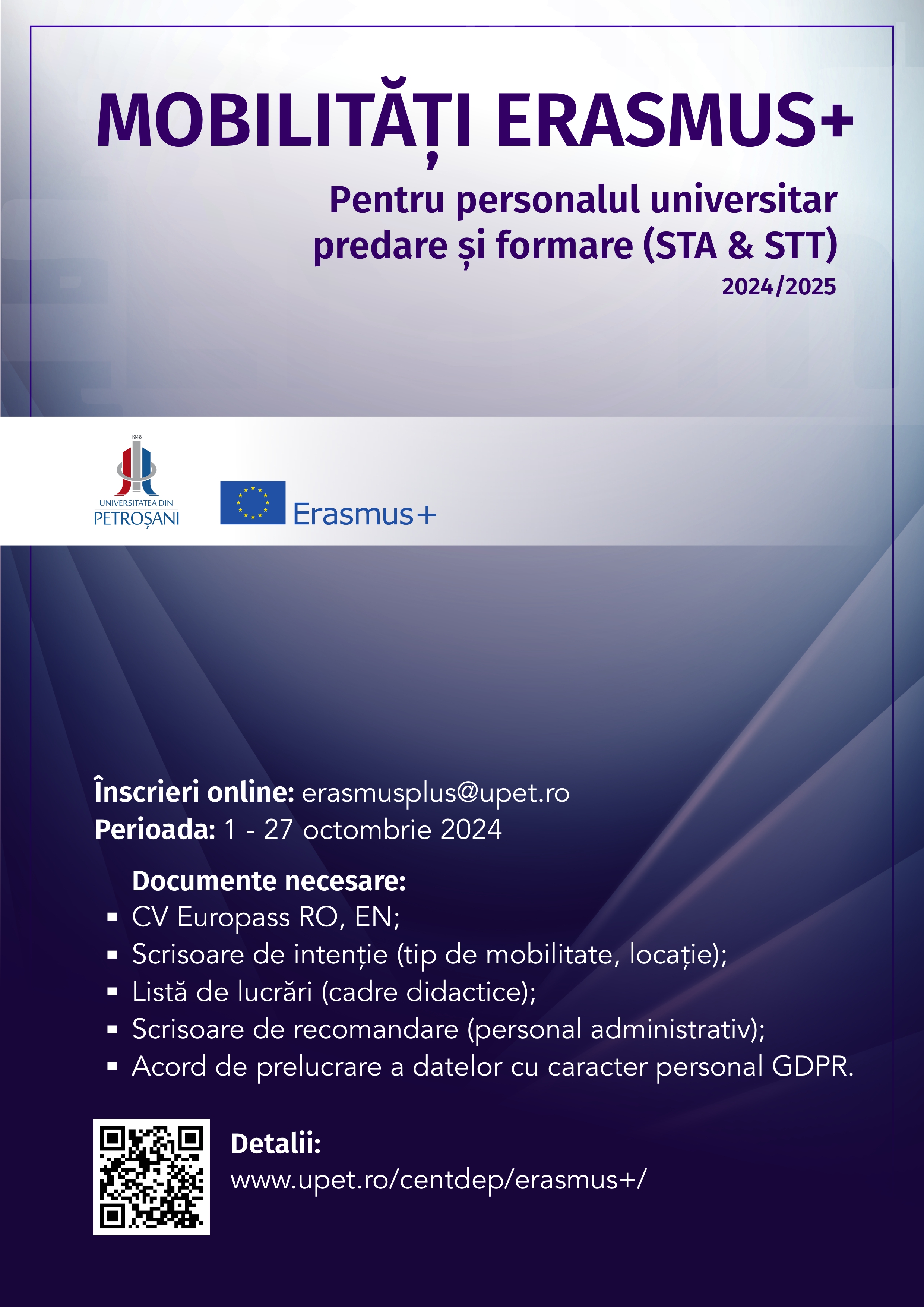
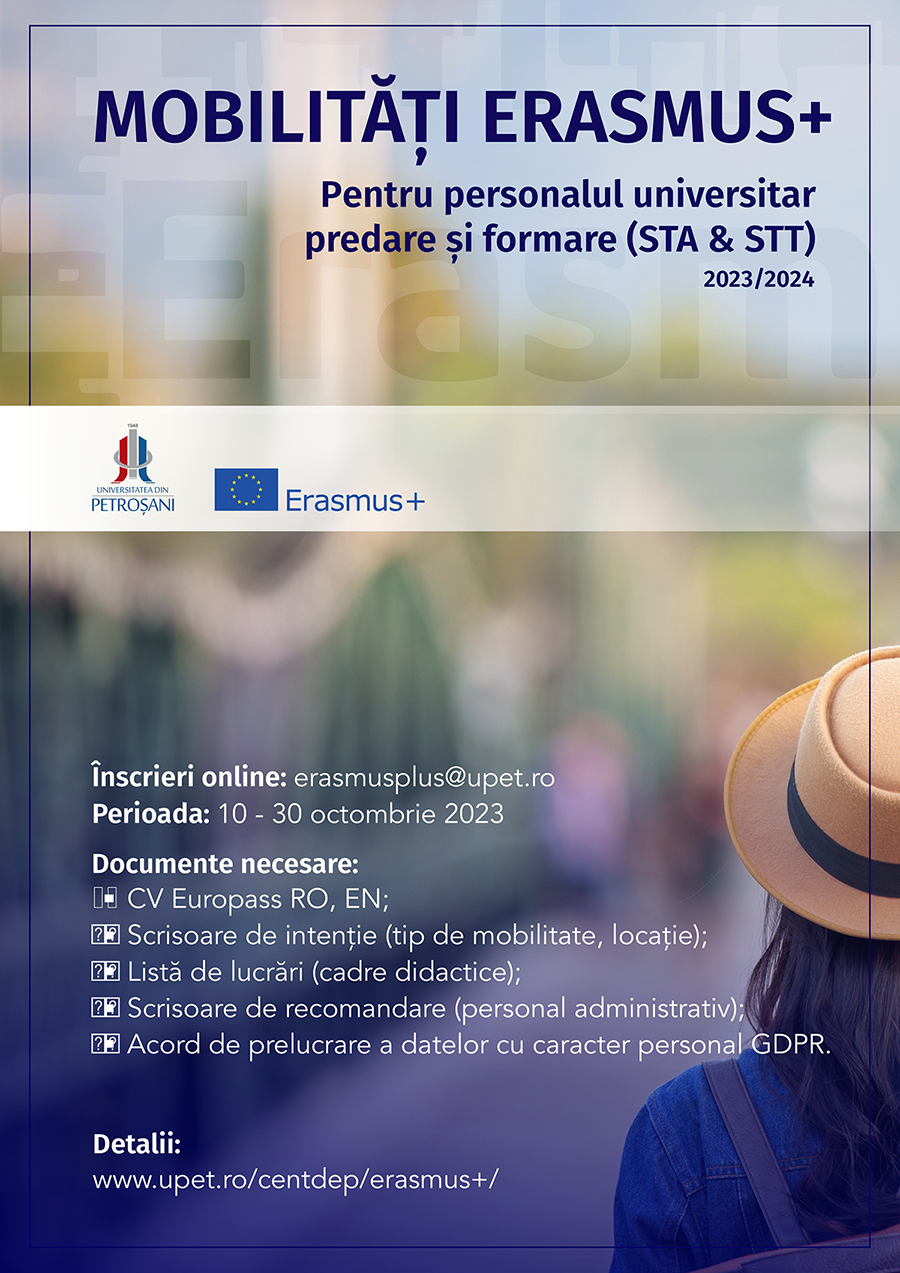
DOCUMENTS REQUIRED FOR THE APPLICATION FILE
- The application (letter of intent) for a teaching or training mobility is signed and submitted in original with the application file.
- CV, in European format with inserted photo, in Romanian and English;
- List of relevant papers
- Proposed teaching/training programme
- Copy of identity card
- Declaration of consent to personal data processing
BEFORE mobility takes place:
- Selection of teachers and other staff is carried out
- The Mobility Agreement is formally approved by the 2 institutions involved
- The financial contract is concluded
- An advance of 80% (up to 100%) of the total grant is paid DURING the mobility:
- In the case of teaching mobility, at least 10 hours must be taught
- In the case of training, the grant is awarded for vocational training
- The duration of the mobility, whether teaching or training, can be between 2 working days and 2 months (excluding travel days)
- The certificate of participation must be issued at the end of the mobility by the host institution/organisation
AFTER returning from mobility:
- The teacher/professor must submit to the Erasmus+ Office the documents proving the mobility, together with the final narrative report.
- If it is complete and found to be fulfilled the remainder of the grant (20%) will be allocated, if applicable
- It is necessary that the beneficiaries who have carried out mobilities participate in the events organized by the University of Petroșani to disseminate information about their experiences and to promote the Erasmus+ programme.
The Erasmus grant is a contribution towards the costs of transport and subsistence for a period of teaching or training abroad. Subsistence costs are set by the European Commission in the Erasmus+ Guide
http://ec.europa.eu/programmes/erasmus-plus/documents/erasmus-plus-programme-guide_en.pdf.
These costs are paid as lump sums. Original certificates of participation signed and stamped by the host university/organisation, specifying the name of the beneficiary and the period spent, must be kept to prove subsistence costs. Subsistence covers: accommodation, meals, local transport, telecommunication costs including fax and internet, insurance and any other expenses. Transport costs are calculated using the Distance Calculator, http://erasmus-plus.ro/ro/erasmus-calculator-distante-de-calatorie-si-regulile-bugetare. These costs are paid as lump sums.
Studies - Course Catalog
Faculty of Mechanical and Electrical Engineering
- Applied Automation and Information
- Computer Science
- Electromechanics
- Equipment for Industrial Processes
- Industrial Power Engineering
- Machine Building Technology
- Mining Machinery and Equipment
- Transportation and Traffic Engineering
- Transportation Systems for Industry, Tourism, and Services
- Operation of Industrial Electrical Installations
- Electromechanical Systems
- Computer-Aided Design and Manufacturing
- Installations and Equipment for Mechanical Processes
- Mining Process Facilities and Equipment
- Information Systems and Technologies
- Applied Information Techniques and Technologies
Faculty of Mining
Engineering in Construction
IMIEDA706—Industrial Marketing.
IMIEDOE304—Basics of Management.
IMIEDOE410-Microeconomics.
IMIEFO101—Mathematical Analysis.
IMIEFO103-Chemistry.
IMIEFOI02—Linear Algebra, Analytical and Differential Geometry.
Industrial Environmental Engineering and Protection
MDPMDI304—Methods for Separating Pollutants.
MDPMDI413-Electrochemistry.
MDPMFO101—Mathematical Analysis.
MDPMFO102—Linear Algebra, Analytical and Differential Geometry.
MDPMFO103-Chemistry.
MDPMSO610—Methods and Instruments for Determining the Quality of Environmental Factors.
Mining Engineering
MNIMDA706—Economics of Mining Units.
MNIMDA708—Mining Legislation.
MNIMDO703-Occupational Safety and Health – (2).
MNIMFO101—Mathematical Analysis.
MNIMFO102—Linear Algebra, Analytical and Differential Geometry.
MNIMSA817—Risk Assessment in the Mining Industry—.
MNIMSO612-Ventilation.
Mining Surveying
MNTCSO229—Underground Mining Structures.
Quality Engineering and Management
IDMCDA708—Diagnostic Analysis.
IDMCDA709-Industrial Economy..
IDMCDO220—Industrial Management I.
IDMCDO222-Quality Motivation.
IDMCDO231—Industrial Management II.
IDMCDO609-Ergonomics.
IDMCFO101—Mathematical Analysis.
IDMCFO102—Linear Algebra, Analytical and Differential Geometry.
IDMCFO103-Chemistry.
IDMCS0613-Commodities Science.
IDMCSO228—Microeconomics.
IDMCSO505—Industrial Marketing.
IDMCSO813—Strategic Management.
Safety Engineering in Industry
IDIS00501-Management.
IDISCO614—General Economics.
IDISDO613—Machine Safety.
IDISFO101—Mathematical Analysis.
IDISFO102—Linear Algebra, Analytical and Differential Geometry.
IDISSA708—Emergency Situations Management—.
IDISSO502—Legislation on Occupational Safety and Health.
IDISSO609—Occupational Risk Assessment.
IDISSO610—Occupational Risk Prevention.
IDISSO611-Ergonomics.
IDISSO703—Auditing and Certification in Industrial Safety Engineering.
IDISSO809—Laboratory Safety and Health Management.
IDISSO812—Elements of Occupational Medicine—.
IDISSO813—Risk Management.
Underground structures
CVCMS0704-Ventilation_Occupational Safety and Health.
CVCMSO501—Underground Mining Structures I.
CVCMSO610—Underground Mining Structures II.
ICCMCO108—Academic Ethics and Integrity.
ICCMFO101—Mathematical Analysis.
ICCMFO102—Linear Algebra, Analytical and Differential Geometry.
Electrical and Mechanical Engineering
Applied Automation and Information Processing
2SA1OD05 – Electrical Engineering.
2SA1OF01 – Linear Algebra, Analytical and Differential Geometry.
2SA1OF02 – Mathematical Analysis.
2SA1OF03 – Applied Informatics.
2SA1OF06 – Chemistry.
2SA1OX06 OP11 – Ethics and Academic Integrity.
2SA1OX06 OP11—Communication.
2SA2OD09 – Electrical Machines and Drives.
2SA2OD12 – Linear Electronic Circuits.
2SA2OF10 – Computer-Aided Graphics.
2SA2OF11 – Computer Programming, Programming Languages I.
2SA2OF13 – Physics.
2SA3AF16 OP21 – Numerical Methods.
2SA3AF16 OP21 – Special Mathematics.
2SA3OD17 – Analysis and Synthesis of Digital Devices.
2SA3OD19 – Measurements and Transducers I.
2SA3OD20 – Databases.
2SA3OF18 – Computer Programming, Programming Languages II.
2SA4OD23 – Digital Electronics.
2SA4OD24 – Software Systems Engineering-Pop.
2SA4OD25 – Computer Architecture.
2SA4OD26 – Systems Theory 1.
2SA4OD27 – Robotics.
2SA5AS37 OP31 – Hydraulic and Pneumatic Systems
2SA5AS37 OP31 – Hydropneumatic Equipment
2SA5OD31 – Systems Theory II.
2SA5OD32 – Microprocessor systems.
2SA5OD35 – Modeling, Identification, and Simulation.
2SA5OD36 – Measurement and Transducers II.
2SA5OS34 – Power Electronics.
2SA6AS42 OP32 – Artificial Intelligence.
2SA6AS42 OP32 – Expert Systems in System Control.
2SA6AS43 – Object-Oriented Programming I.
2SA6OD40 – Automated Systems Engineering
2SA6OD41 – Optimizations.
2SA6OS38 – Microcontrollers – Architecture and Programming.
2SA6OS44 – Reliability and Diagnosis.
2SA7AS49 OP41 – Control Systems for Technological Processes
2SA7AS49 OP41 – Continuous Process Control Systems
2SA7AS50 OP42 – Data acquisition systems.
2SA7AS51 OP43 – Computer Networks in Automation.
2SA7AS51 OP43 – Industrial Computer Networks.
2SA7OS46 – Fuzzy Systems and Neural Networks.
2SA7OS47 – Robots.
2SA7OS48 – IQ circuits and process interfaces.
2SA8AS52 OP44 – Electrical and electronic automation equipment.
2SA8AS52 OP44 – Electrical control components.
2SA8AS53 OP45 – Operating Systems in Automation.
2SA8AS53 OP45 – Real-Time Software Design.
2SA8AS55 OP47 – Automation in Industrial Applications.
2SA8AS55 OP47 – Automation of complex processes.
2SA8OS56 – Data Transmission.
Computers
2CC1OD04 – Electrical Engineering.
2CC1OF01 – Linear Algebra, Analytical and Differential Geometry.
2CC1OF02 – Mathematical Analysis.
2CC1OF03 – Applied Informatics.
2CC1OF05 – Chemistry.
2CC1OX06 OP 11 – Communication.
2CC1OX06 OP 11 – Ethics and Academic Integrity.
2CC2OD09 – Algorithm Design.
2CC2OF10 – Computer-Aided Graphics.
2CC2OF11 – Computer Programming, Programming Languages I.
2CC2OF13 – Physics.
2CC2OX12 – Electronic Devices and Analog Electronics.
2CC3AF16 OP21 – Numerical Methods.
2CC3AF16 OP21 – Special Mathematics.
2CC3OD17 – Logic Design.
2CC3OD19 – Databases.
2CC3OD20 – Electronic Measurements, Sensors, and Transducers.
2CC3OF18 – Computer Programming, Programming Languages II.
2CC4OD23 – Digital Electronics.
2CC4OD24 – Software Engineering.
2CC4OD25 – Object-Oriented Programming I.
2CC4OD26 – Systems Theory I.
2CC4OD27 – Computer Architecture.
2CC5AS37 OP31 – e-Commerce.
2CC5AS37 OP31 – Web Application Design.
2CC5OD32 – Microprocessor Design.
2CC5OD34 – Systems Theory II.
2CC5OD36 – Modeling and Simulation.
2CC5OS31 – Human-Machine Interaction.
2CC5OS35 – Robots.
2CC6AS42 OP32 – Software Reliability.
2CC6AS44 OP 33 – Knowledge-Based Systems.
2CC6AS44 OP33 – Intelligent Systems.
2CC6OD40 – Digital computers.
2CC6OD41 – Formal Languages and Translators.
2CC6OD43 – Artificial Intelligence.
2CC6OS38 – Microcontrollers.
2CC7AD49 OP41 – Data acquisition and processing.
2CC7AD49 OP41—Virtual Instrumentation.
2CC7AS50 OP42 – Graphics Processing.
2CC7AS50 OP42 – Image Processing.
2CC7AS51 OP43 – Input-Output Systems and Peripheral Devices.
2CC7AS51 OP43 – User Interface Design.
2CC7OS46 – Computer Networks.
2CC7OS47 – Elements of Mobile Informatics.
2CC7OS48 – Multimedia Systems.
2CC8AD55 OP46 – Logic Programming.
2CC8AD55 OP46 – Operating Systems.
2CC8AS53 OP44 – Database Design.
2CC8AS54 OP45 – Project Design Methodology.
2CC8AS54 OP45 – Project Management.
2CC8OS52 – Computer Networks Design.
2CC8OS56 – Communication Protocols.
Electromechanics
2EE1AX07 OP11 – Ethics and Academic Integrity.
2EE1AX07 OP11 – Professional Communication.
2EE1OD03 – Mechanics.
2EE1OD06 – Electromagnetic Field Theory.
2EE1OF01 – Linear Algebra, Coordinate and Differential Geometry.
2EE1OF02 – Mathematical Analysis.
2EE1OF04 – Applied Software.
2EE1OF08 – Chemistry.
2EE2AF14 OP12 – Numerical Methods.
2EE2AF14 OP12 – Special Mathematics.
2EE2OD13—Electric Circuits Theory I.
2EE2OD15 – Technological Methods and Procedures
2EE2OD16 – Electronics.
2EE2OF11 – Computer-Aided Graphics I.
2EE2OF12 – Physics.
2EE3OD19 – Theory of Electrical Circuits II.
2EE3OD20 – Electrical and Electronic Measurement I.
2EE3OD23 – Electrical Equipment.
2EE3OD24 – Electrical Machines I.
2EE3OF18 – Computer Programming, Programming Languages I.
2EE3OS21 – Strength of Materials.
2EE4AD31 – Electromagnetic Compatibility.
2EE4OD26 – Electrical and Electronic Measurement.
2EE4OD28 – Electrical Machines II
2EE4OD30 – Electrical Engineering Materials.
2EE4OF29 – Computer-Aided Graphics II.
2EE4OF32 – Computer Programming, Programming Languages II.
2EE5OD36 – Transducers, Interfaces, and Data Acquisition.
2EE5OD38 – Numerical Equipment for Electromechanical Installations.
2EE5OD39 OP31 – Power sources.
2EE5OD39 OP31 – Management.
2EE5OD41 – Static Converters I
2EE5OS35 – Industrial Instrumentation.
2EE5OS37 – Thermodynamics.
2EE5OS40 – Industrial Electromechanical Systems.
2EE6AS46 OP32 – Mechanisms and Machine Parts.
2EE6AS46 OP32 – Mechatronics.
2EE6AS47 OP33 – Electromechanical Equipment Manufacturing Technology.
2EE6AS47 OP33 – Operation and Reliability of Electromechanical Systems.
2EE6OD42 – Static Converters II
2EE6OD43 – Static Converters II – Project
2EE6OD44 – Quality and Reliability.
2EE6OD45 – Hydraulic and Pneumatic Drives
2EE6OD48 – Systems Theory and Automatic Control
2EE7AS53 OP41 – Electrothermics.
2EE7AS53 OP41 – Electrical Technologies.
2EE7OD54 – Microprocessor Systems.
2EE7OD56 – Microcontrollers and Integrated Systems.
2EE7OS50 – Electrical Installations I.
2EE7OS51 – Electric Drive Systems I.
2EE7OS52 – Modeling and Simulation in Electrical Engineering
2EE7OS55 – Computer-Aided Process Control.
2EE8AS60 OP42 – Stations and Transformer Substations.
2EE8AS60 OP42 – Use of electricity.
2EE8OS57 – Electrical Installations II.
2EE8OS58 – Electrical Installations II – Project.
2EE8OS59 – Electric Drive Systems II.
2EE8OS61 OP43 – Electric Traction.
2EE8OS61 OP43 – Special Electrical Machines.
2EE8OS62 – Analog and Digital Transmissions.
2EE8OS63 – Servosystems.
Equipment for industrial processes
2MU1OD06 – Mechanics – I.
2MU2OD13-Mechanics II.
2MU3OD17—Thermotechnics and Thermal Machines.
2MU3OX22—History of Technology and Science.
2MU4OD26 – Machine Parts I
2MU4OD29—Tolerance and Dimension Control
2MU5OD37—Fluid Mechanics and Hydraulic Machines.
2MU5OD38—Machine Parts II
2MU5OD39—Machine Parts II
2MU5OS41—Reliability and Maintenance Products.
2MU6OS45—Process Machinery and Installation.
2MU7OS52—Lifting and Transporting Equipment I.
2MU7OS53—Design of Process Equipment I.
2MU8OS57 – Lifting and Transport Systems II.
2MU8OS59—Design of Process Equipment II.
2MU8OS60—Fabrication Engineering of Process Equipment.
Industrial Power Engineering
2II1AX07 OP11 – Ethics and Academic Integrity.
2II1AX07 OP11 – Professional Communication.
2II1OD03 Mechanics.
2II1OD06 – Fundamentals of Electrical Engineering I.
2II1OF01 – Linear Algebra, Coordinate and Differential Geometry.
2II1OF02 – Mathematical Analysis.
2II1OF04 – Applied Software.
2II1OF08 – Chemistry.
2II2OD16 – Materials Technology
2II2OD17 – Electronics.
2II2OF11 – Fundamentals of Electrical Engineering II.
2II2OF12 – Computer-Aided Graphics I.
2II2OF13 – Physics.
2II2OF14 OP12 – Numerical Methods.
2II2OF14 OP12 – Special Mathematics.
2II3OD20 – Measurement of Electrical and Non-Electrical Quantities 1.
2II3OD22 – Strength of Materials.
2II3OD25 – Hydraulic Machines
2II3OF19 – Computer Programming and Programming Languages I.
2II3OF24 – Computer-Aided Graphics II.
2II4OD21 – Thermodynamics.
2II4OD27 – Heat and Mass Transfer.
2II4OD29 – Renewable Sources.
2II4OD30 – Generation of Electricity and Thermal Energy I.
2II4OD33 – Thermal Equipment and Installations.
2II4OF32—Computer Programming and Programming Languages II.
2II4OS34 – Electrical Engineering Materials.
2II5OD37 – Electrical Equipment.
2II5OD38 – Fluid Mechanics.
2II5OD39 – Electrical Networks I.
2II5OD40 – Electrical Machines and Drives I.
2II5OD41 – Electrical Section of Power Plants and Stations I.
2II5OD42 – Generation of Electricity and Thermal Energy II.
2II6AD47 – Electrical Networks II.
2II6AS44 OP31 – Machine Parts.
2II6OD43 – Electrical Machines and Drives II
2II6OD45 – Electrical Section of Power Plants and Stations II.
2II6OD46 – Reliability.
2II6OD49 – Automatic Control Theory
2II6OS48 OP32 – Pumping and Ventilation Systems
2II6OS48 OP32 – Turbomachines
2II7AD55 OP41 – Energy and the Environment.
2II7AD55 OP41 – Management.
2II7AS56 – Power Systems Optimization.
2II7OS51 – Numerical Control Systems.
2II7OS52 – Power Electronics.
2II7OS53 – Power Electronics – Project
2II7OS54 – Energy Process Control.
2II8AS60 OP42—Use of electricity.
2II8AS62 OP43 – Relay Protection.
2II8AS62 OP43 – Stations and Transformer Substations.
2II8OS58 – Virtual Instrumentation.
2II8OS59 – Data Acquisition Systems in Power Engineering.
2II8OS61 – Electrical Equipment-Network Interaction.
Machine Building Technology
2BB1OD02—Materials Science and Engineering
2BB1OD06-Mechanics I
2BB1OF01-Chemistry
2BB1OF03—Mathematical Analysis
2BB1OF04—Descriptive Geometry
2BB1OF05-Applied Informatics I
2BB2OD10-Mechanics II
2BB2OD11-Materials Technology
2BB2OF09-Applied Informatics II
2BB2OF12—Algebra, Analytical and Differential Geometry
2BB2OF13—Technical Drawing
2BB2OF14-Physics
2BB3OD17—Thermotechnics and Thermal Machines
2BB3OD20-Mechanisms
2BB3OD22-Strength of Materials I
2BB3OF18a—Special Mathematics
2BB3OF18b—Numerical Methods
2BB3OF21-Infographics (CAD) I
2BB3OX19—History of the Technique
2BB4AX32 – Environmental Protection
2BB4LX67—General Economy
2BB4OD26-Strength of Materials II
2BB4OD27—Mechanical Vibrations
2BB4OD28—Tolerance and Dimension Control
2BB4OD29-Machine Parts I
2BB4OD30 – Basics of Surface Generation on Machine Tools
2BB4OF25-Infographics (CAD) II
2BB5OD35—Fluid Mechanics and Hydraulic Machines
2BB5OD36—Electrical Engineering and Machinery
2BB5OD37—Finite Element Analysis
2BB5OD38—Machine Parts II
2BB5OD39-Machine Parts II – Project
2BB5OD40—Elements of Electronics and Automation
2BB5OD41 – Machining and Cutting Tools
2BB6AS48a—Production and Operations Management
2BB6AS48b—Economic Analysis of Production Systems
2BB6AS63—Hydraulic and Pneumatic Drives
2BB6OD42-Tribology
2BB6OD43—Technological Devices
2BB6OD44-Machine Tools
2BB6OD45—Thermal Treatments
2BB7OD51—Basics of Computer-Aided Technical Design
2BB7OD52—Reliability and Maintenance
2BB7OS54—Technology of Cold Pressing
2BB7OS55—Technology of Cold Pressing—Project
2BB7OS57—Foundations of Experimental Research
2BB7OS57-Machine Building Technology I
2BB8AS62—Technological Design of Flexible Manufacturing Systems
2BB8AS63-Computer-Assisted Quality (CAQ)
2BB8LS74-Mechatronics
2BB8OS58-Machine Building Technology II
2BB8OS59-Machine Building Technology II – Project
2BB8OS60—Unconventional Technologies
2BB8OS61—Manufacture of plastic and composite products
Mining machinery and equipment
2MM1OD06 Mechanics – I.
2MM1OF02-Chemistry.
2MM2OD13 Mechanics II.
2MM3OD17—Thermotechnics and Thermal Machines.
2MM4OD26 – Machine Parts I
2MM4OD29—Tolerance and Dimension Control
2MM5OD37 Fluid Mechanics and Hydraulic Machines.
2MM5OD38 – Machine Parts II
2MM5OD39—Machine Parts II
2MM5OS41—Reliability and Maintenance.
2MM6OD47—Tribology.
2MM6OS44 – Safety in the Mining Industry-.
2MM7OS52—Mining Loading and Transportation Equipment (Part I).
2MM8OS53—Mining Machinery and Equipment I.
2MM8OS58-OP42-Unconventional Technologies in Machine Fabrication
2MM8OS59—Mining Machinery and Equipment II.
Transportation and Traffic Engineering
2TT1OD07 Mechanics.
2TT1OF01 Mathematical Analysis
2TT1OF02-Chemistry.
2TT3OD13 – Economic Analysis of Transportation.
2TT3OD17—Thermotechnics and Thermal Machines.
2TT3OD29 – Internal combustion engines.
2TT4OD26 – Machine Parts
2TT4OF37—Fluid Mechanics and Hydraulic Machines.
2TT4OS30 – Risk Assessment and Insurance in Transportation.
2TT5OD28—Means of transportation.
2TT5OD38 – Multimodal Transport.
2TT5OS35—Vehicle Dynamics.
2TT5OS42—Geography of Transportation.
2TT6OS44—Road Transport Systems.
2TT6OS49-GIS GPS Systems.
2TT7LS68—Underground transportation equipment.
2TT7OD54—Transport Terminals and Technologies.
2TT7OS52—Reliability of Transportation Systems.
2TT7OS53—Traffic Analysis.
2TT7OS56—Transportation infrastructure.
2TT8AS59 OP42 – Road Accident Analysis.
2TT8LS71—Quality in Transportation.
2TT8OS61—Industrial transportation.
Master
Applied Computer Techniques and Technologies
2TTIA1AS05 OP 11 – Database Systems.
2TTIA1AS07 – Modern Communication Technologies in Computer Networks.
2TTIA1AS17 Software Applications for Mobile Devices.
2TTIA1OS01—Algorithm Design and Analysis.
2TTIA1OS02 – Data Science.
2TTIA1OS03 – Software Applications in Biomedicine.
2TTIA1OS04 – Ethics and Academic Integrity.
2TTIA1OS06 – Software Applications in the Automotive Industry.
2TTIA1OS08 – Neural Networks and Machine Learning.
2TTIA1OS11—Software Applications for Mobile Robots.
2TTIA1OS12 – HDL Programming.
2TTIA1OS13 OP21 – Project Management.
2TTIA1OS13 OP21 – Quality Management.
2TTIA1OS14 – Software Applications for Renewable Energy Systems I.
2TTIA1OS15 OP22 – Blockchain-based software applications.
2TTIA1OS15 OP22 – Sensor networks.
2TTIA1OS18 – Human-Machine Interfaces.
2TTIA2OC09 – Communication in English.
Computer-Aided Design and Manufacturing
2CFACCOD07 – Syllabus: Assisted Quality Management.
2CFACOD03—Assisted Maintenance in Manufacturing Systems.
2CFACOD17 – Risk Analysis of Product Manufacturing.
2CFACOS11-Rapid Prototyping.
2CFACXS13-OP21-Computer-Assisted Experimental Research.
Electromechanical Systems
2MSEAD04 OP11 – Analysis of Electrical Circuits.
2MSEAD04 OP11 – Special Topics in Electrical Engineering.
2MSEAD12 OP21 – Quality of Electricity and Energy Process Efficiency.
2MSEAD12 OP21—Electromechanical system with high energy efficiency.
2MSEAD17 OP22 – Investment Management.
2MSEAD17 OP22 – Quality Management.
2MSEAS09 OP12 – Electrical System Safety.
2MSEAS09 OP12 – Maintenance and Monitoring of Industrial Electrical Equipment.
2MSEOC05 – Ethics and Academic Integrity.
2MSEOD01 – Electromechanical Systems.
2MSEOD03 – Sensors and Instrumentation for Electromechanical Systems.
2MSEOD07 – Smart Static Power Converters
2MSEOD13 – Data Teletransmission in Electromechanical Systems.
2MSEOS02 – Numerical Methods in Electrical Engineering.
2MSEOS06 – Modern Solutions in the Design and Construction of Electromechanical Systems.
2MSEOS08 – Modeling and Simulation of Systems and Processes
2MSEOS11 – Adjustable Drive Control
2MSEOS14 – Special Electric Machines.
2MSEOS16 – Control Algorithms and Processors
MEIEI Operation of Industrial Electrical Installations
2MEIEIAD04 OP12 – Optimization of Power Grid Operations.
2MEIEIAD04 OP12 – Smart Power Grids.
2MEIEIAD14 OP 21 – Energy Diagnosis and Prognosis.
2MEIEIAD14 OP 21 – Reliability and Controllability of the Distribution Grid.
2MEIEIAD16 OP22 – Modern Energy Conversion Systems.
2MEIEIAD16 OP22 – The Efficiency of Energy Processes.
2MEIEIAS02 OP11 – Electricity Quality and Conservation.
2MEIEIAS02 OP11 – Electromechanical Systems with High Energy Efficiency.
2MEIEIOC05 – Ethics and Academic Integrity.
2MEIEIOD01 – Control and Data Acquisition Systems in Electrical Installations.
2MEIEIOD03 – Modeling of Electric Machines.
2MEIEIOD06 – Modern Solutions in the Design and Construction of Power Systems.
2MEIEIOD07 – Smart Static Power Converters
2MEIEIOD17 – Control Algorithms and Processors
2MEIEIOS08 – Digital Protection in Power Systems.
2MEIEIOS09 – Modeling and Simulation of Electrical Installations
2MEIEIOS11 – Transient Regimes of Electrical Machines.
2MEIEIOS12 – Electric Servo Drives with Vector Control
2MEIEIOS13 – Data Telemanagement Systems in Power Engineering.
MMIN
2MMINOS16—Construction Machinery, Road Construction, and Mining II.
MMM
2MMMOS12—Machinery and Equipment for Infrastructure I.
2MMMOS16—Machinery and Equipment for Infrastructure II.
Systems and Information Technology
2STI1AD04 – Ethics and Academic Integrity.
2STI1OD01 – Image Processing and Virtual Reality.
2STI1OD05 OP11 – Advanced Identification Techniques.
2STI1OD05 OP11 – Modeling of Complex Systems.
2STI1OS03 – Adjustable Drives and Actuators
2STI2OC09 – English Communication.
2STI2OD06 – Algorithms and Process Control Structures.
2STI2OS07 – Supervisory Control and Data Acquisition.
2STI2OS08 – Artificial Intelligence.
2STI3AS13 OP21 – Advanced Control in Robotics.
2STI3OD11 – Information Systems for Explosive Environments.
2STI3OS12 – Development of Embedded Systems Using VLSI Technologies.
2STI3OS14 OP22 – Flexible Manufacturing Systems.
2STI3OS14 OP22 – Intelligent Control Systems.
2STI4OS16 – Information Systems in the Automotive Industry.
Transportation systems for industry, tourism, and services
2STITSOD16 – Risk Assessment in Transportation.
Faculty of Economic, Administrative, and Social Sciences
Accounting and Information Management
C.C.1.1.02—Microeconomics.
C.C.1.1.03—Fundamentals of Accounting I.
C.C.1.1.06—Corporate Economics.
C.C.1.2.09—Macroeconomics.
C.C.1.2.10—Statistics
C.C.1.2.11—Fundamentals of Accounting II.
C.C.1.2.14—Economic Doctrines.
C.C.2.1.02—Financial Accounting I.
C.C.2.1.04—Information Systems for Decision Making.
C.C.2.1.15—Management Information Systems Development.
C.C.2.2.09—Financial Accounting II.
C.C.2.2.12—Money and Credit.
C.C.3.1.01—Management Accounting.
C.C.3.1.02—Financial Audit.
C.C.3.1.03—Company Evaluation.
C.C.3.2.09—Public Accounting.
C.C.3.2.17—Capital Markets.
C.CA.O.4.08—Methodology of Scientific Research.
Economics of Trade, Tourism, and Services
C.G.1.1.01—Applied Mathematics for Economics.
C.G.1.1.02—Microeconomics.
C.G.1.1.03—Corporate Economics.
C.G.1.1.05—General Management.
C.G.1.2.10—Macroeconomics.
C.G.1.2.11—Fundamentals of Accounting.
C.G.1.2.12—Statistics
C.G.1.2.13—Marketing.
C.G.1.2.14—Fundamentals of Law.
C.G.2.1.02—Economics of Trade.
C.G.2.1.03—Economics of Services.
C.G.2.1.04—Fundamentals of Commodity Science.
C.G.2.1.15—Hotel and Restaurant Technology.
C.G.2.2.09—Economics of Tourism.
C.G.2.2.10—Finance.
C.G.2.2.11—Commercial communication.
C.G.3.1.01—Banking Operations.
C.G.3.1.03 – Insurance and Reinsurance.
C.G.3.1.04 – Economic and Financial Analysis.
C.G.3.1.05—Business Management in Trade, Tourism, and Services (ECTS).
C.G.3.1.13—Shipping and insurance for passengers and goods.
C.G.3.2.07—Commercial Transactions.
C.G.3.2.08 – Technical Tourism.
C.G.3.2.09—Entrepreneurship.
C.G.3.2.10—Business Investment Strategies.
C.G.3.2.11—Logistics and Distribution of Goods.
C.G.3.2.16—Prices and Competition.
Finance and Banking
C.B.1.1.01 – Applied Mathematics for Economics.
C.B.1.1.02—Microeconomics.
C.B.1.1.03—Fundamentals of Law.
C.B.1.1.05—General management.
C.B.1.2.09—Public Finance.
C.B.1.2.10—Macroeconomics.
C.B.1.2.11—Statistics
C.B.1.2.13—Marketing.
C.B.1.2.14—Social insurance protection.
C.B.2.1.01 – Insurance and Reinsurance.
C.B.2.1.02—Financial Investments.
C.B.2.1.03—Operation of a Credit Institution
C.B.2.1.04—Financial Accounting.
C.B.2.1.16—Financial Management of Public Institutions.
C.B.2.1.19—Corporate Economics.
C.B.2.2.09—Management Control.
C.B.2.2.10—Corporate Financial Management.
C.B.2.2.11—Banking products and services.
C.B.2.2.12—Money and Credit.
C.B.2.2.17—Entrepreneurship.
C.B.3.1.01—Accounting for Credit Institutions.
C.B.3.1.02—International Finance.
C.B.3.1.03—Bank Management.
C.B.3.1.04-Office Technologies.
C.B.3.1.05—Corporate Evaluation.
C.B.3.1.14—Economic Forecast.
C.B.3.2.07—Prices and Competition.
C.B.3.2.08 – Economic and Financial Analysis.
C.B.3.2.09—Capital Markets.
C.B.3.2.10—Budget and Public Treasury.
C.B.3.2.16—International banking institution.
C.B.3.2.18—Business Investment Strategies.
Management
C.A.1.1.01—Applied Mathematics for Economics.
C.A.1.1.02_Microeconomics.
C.A.1.1.03—Fundamentals of Law.
C.A.1.1.05—General Management.
C.A.1.1.06-Management-Informatics-MN-I.
C.A.1.2.09_Macroeconomics.
C.A.1.2.10—Statistics
C.A.1.2.11—Marketing.
C.A.1.2.12—Fundamentals of Accounting.
C.A.1.2.13—Public Finance.
C.A.1.2.14—Economic Doctrines.
C.A.2.1.01 – Innovation Management.
C.A.2.1.02—Investment Management.
C.A.2.1.03—Financial Accounting.
C.A.2.1.04—Applied Microeconomics.
C.A.2.1.15—Business Project Management.
C.A.2.2.09—Human Resources Management.
C.A.2.2.10—Business Law.
C.A.2.2.11 – Supply and Sales Management.
C.A.2.2.12 – Quality Management.
C.A.2.2.17 – Communication and Business Negotiation.
C.A.3.1.02—Services Management.
C.A.3.1.03 – Economic and Financial Analysis.
C.A.3.1.04—Strategic Management.
C.A.3.1.05—Management of Small and Medium-Sized Enterprises.
C.A.3.1.12—Economic Forecast.
C.A.3.2.06—Economic projects.
C.A.3.2.07—Diagnosis and Analysis of Enterprise Evaluation.
C.A.3.2.11—Development of a bachelor’s thesis.
C.A.3.2.14—Comparative Management.
C.A.3.2.15—Audit.
C.A.3.2.16—Business Investment Strategies.
Public Administration
C.H.1.1.01—Microeconomics.
C.H.1.1.02—General Theory of Law.
C.H.1.1.03—Accounting for Public Institutions
C.H.1.1.06—Informatics for Public Administration.
C.H.1.2.12—Macroeconomics.
C.H.2.1.13—Public Audit and Managerial Performance
C.H.2.1.14—Implementation of EU Programs.
C.H.2.2.10—Strategic Planning.
C.H.2.2.18—Social Statistics
C.H.3.1.15—Public Procurement.
C.H.3.2.18—Public Sector Economy.
C.H.3.2.19—Regional Economy.
Social Work
C.I.1.1.01-Social Policies – Copy
C.I.1.1.01—Social Policies
C.I.1.1.05—SOCIAL INFORMATICS.
C.I.1.1.2.10—Introduction to Economics AS.
C.I.1.2.09—Research Methodology in the Social Sciences.
C.I.1.2.10—Introduction to Economics.
C.I.1.2.11—Introduction to Social Work.
C.I.1.2.12—Professional Ethics – Copy
C.I.1.2.12—Professional Ethics
C.I.1.2.14—Statistical Data Processing.
C.I.1.2.14-Statistical-Data-Processing-AS-I.
C.I.2.1.15—Social work for people with disabilities.
C.I.3.1.01-Social Work for the Family En.
C.I.3.1.04—Social work for people with chronic and terminal illnesses.
C.I.3.1.12—Employment Policy.
C.I.3.2.08—Communication Techniques in Social Work—Copy
C.I.3.2.08—Communication Techniques in Social Work
C.I.3.3.06—Social work for the elderly.
Sociology
C.D. 2.1.02—Social Psychology
C.D.1.1.01—Introduction to Sociology.
C.D.1.1.02—History of Sociology.
C.D.1.1.03—Research Methodology in the Social Sciences.
C.D.1.1.05—Sociology and Psychology.
C.D.1.1.06-Economy SC.
C.D.1.2.09—Paradigms of Sociology.
C.D.1.2.10—Contemporary Sociological Theories.
C.D.1.2.12—Social Anthropology—SC I
C.D.1.2.13—Sociology of Identity.
C.D.1.2.14—Informatics and Database Systems.
C.D.2.1.01—Qualitative Research Methods.
C.D.2.1.04 – Ethics and Academic Integrity.
C.D.2.1.12—Urban and Rural Sociology.
C.D.2.1.14—Sociology of Organizations.
C.D.2.2.08—Quality of Life.
C.D.2.2.09—Demography.
C.D.2.2.18—Sociology of Labor.
C.D.2.2.22 – Sociology of Deviance.
C.D.3.1.01—Sociology of Public Opinion.
C.D.3.1.02—Political Sociology.
C.D.3.1.03—Social Stratification and Mobility.
C.D.3.1.05—Sociology of Globalization.
C.D.3.1.06—Economic Sociology—SC II
C.D.3.1.13 – Sociology of Religion
C.D.3.2.08—Social Policies—SC II
C.D.3.2.15 Professional Ethics – SC III
C.D.3.2.17—Community and Regional Development.
C.D.3.2.20-Organizational Culture_Dronca.
Master
ACCOUNTING AND AUDITING
SC.CA.A.F.4.12—Project Management.
SC.CA.O.1.03—Accounting Theory and Financial Reporting.
SC.CA.O.2.07—International Accounting Standards.
SC.CA.O.2.08—Financial Audit and Corporate Governance.
SC.CA.O.2.09—Advanced Management Accounting.
SC.CA.O.2.10-Internship.
SC.CA.O.3.01 – Advanced Financial Analysis.
SC.CA.O.3.02—Audit and Internal Control
SC.CA.O.3.03—International Auditing Standards
SC.CA.O.3.04—Treasury and Risk Management.
SC.CA.O.3.05—Integrated systems for accounting and management.
SC.CA.O.4.06 – Financial Diagnosis and Business Valuation.
SC.CA.O.4.08—Scientific Research Methodology.
SC.CA.O.4.09—Research and documentation for the development of a master’s thesis.
SC.CA.O.4.10—Ethics and Academic Integrity.
FINANCIAL AND BANKING MANAGEMENT
FB.MFB.A.4.13—Project Management.
FB.MFB.O.1.01—International Monetary Economics.
FB.MFB.O.1.02 – Corporate Finance.
FB.MFB.O.1.04—Audit and Internal Control
FB.MFB.O.1.05—Modern banking products and services.
FB.MFB.O.2.06—Monetary policies.
FB.MFB.O.2.07—Credit Analysis and Lending Management.
FB.MFB.O.3.01—Audit and Bank Accounting.
FB.MFB.O.3.03 – Advanced Financial Analysis.
FB.MFB.O.3.04—Decision Optimization for Banking and Financial Services.
FB.MFB.O.4.07 – Financial Diagnosis and Business Valuation.
FB.MFB.O.4.08—Risk Management and Bank Performance.
FB.MFB.O.4.09 – Scientific Research and Development of the Dissertation.
FB.MFB.O.4.10 – Guidelines for Writing a Master’s Thesis.
FB.MFB.O.4.11—Ethics and Academic Integrity.
STRATEGIC AND BUSINESS MANAGEMENT
MN.MSA. O.1.03—International Business and Globalization.
MN.MSA.A.3.11—Strategic Diagnosis
MN.MSA.A.3.12 – Strategic Organizations.
MN.MSA.O.1.01—Ethics and Corporate Social Responsibility.
MN.MSA.O.1.02—Corporate Financial Management.
MN.MSA.O.1.04 – Strategic Human Resources Management.
MN.MSA.O.2.06—Business and Economics.
MN.MSA.O.2.07-e-Business.
MN.MSA.O.2.08—Strategic Business Planning and Forecasting.
MN.MSA.O.2.09—Managerial Accounting
MN.MSA.O.3.01—Business Management Information Systems.
MN.MSA.O.3.02—Business Management Redesign.
MN.MSA.O.3.03—Strategic Games and Decision Optimization.
MN.MSA.O.3.04—Entrepreneurship and Organizational Culture.
MN.MSA.O.4.06—Total Quality Management.
MN.MSA.O.4.07—Strategic Management Control Process.
MN.MSA.O.4.10—Ethics and Academic Integrity.


.png)
.png)


.png)
.png)